
AI-Native Company: Benefits, Top 10 Business Ideas & The Future of Business
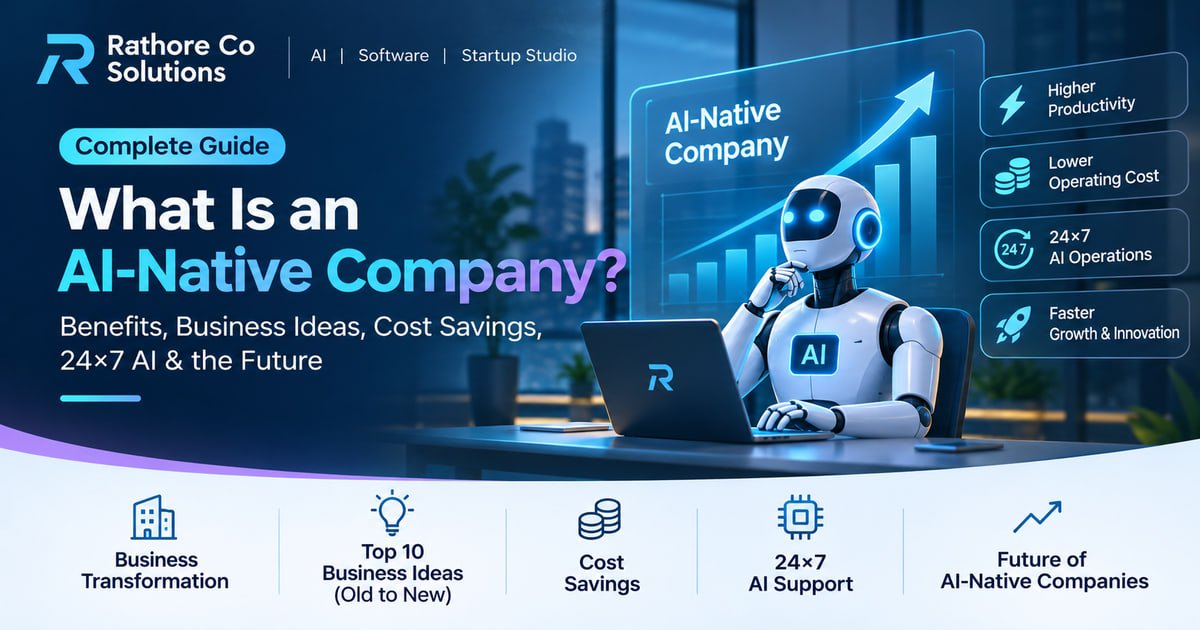
What an AI-native company actually is, how it differs from a business that merely uses AI tools, ten traditional business models that can be rebuilt around AI, where the operating costs change, and how to start without rebuilding everything at once.
The future of business is not just digital. It is AI-native.
Imagine running a business where customer inquiries are answered 24/7, sales leads are qualified automatically, marketing campaigns are optimized using AI, reports are generated in seconds, and repetitive business operations run without requiring constant human intervention.
This is no longer just a futuristic concept. Artificial Intelligence is changing how businesses operate, compete, serve customers, and generate revenue.
A new business model is emerging: the AI-native company.
Unlike traditional businesses that use software to support their employees, AI-native companies integrate artificial intelligence into their core business processes. AI becomes an essential part of how the company thinks, operates, delivers services, and grows.
For startups, entrepreneurs, and established businesses, this shift presents an enormous opportunity.
In this article, we will explore what an AI-native company is, its advantages, the top 10 traditional business models that can be transformed using AI, cost-saving opportunities, 24/7 AI operations, and how Rathore Co Solutions can help businesses make this transformation.
1. What Is an AI-Native Company?
An AI-native company is a business designed from the beginning to use Artificial Intelligence as a core part of its operations, products, services, and decision-making processes.
Instead of simply adding AI tools to existing workflows, an AI-native company redesigns its workflows around AI capabilities.
Traditional companies typically depend on employees to perform repetitive activities, manage customer communication, process information, prepare reports, and handle daily operations.
An AI-native company uses AI agents, automation systems, intelligent software, and integrated data to perform many of these activities automatically, with people supervising important decisions and handling tasks that require human judgment.
Traditional Company vs AI-Native Company
| Traditional business | AI-native business |
|---|---|
| Manual customer support | AI-powered customer support |
| Employees enter data manually | Automated data processing |
| Manual lead follow-ups | AI-powered lead management |
| Fixed working hours | 24/7 AI-assisted operations |
| Manual reporting | Automated business intelligence |
| Traditional marketing | AI-assisted personalized marketing |
| Human-dependent workflows | AI-assisted automated workflows |
| Decisions based on periodic reports | Data-driven, AI-assisted decisions |
The biggest difference: Traditional businesses use technology to make employees more productive. AI-native businesses redesign the entire operating model to make humans and AI work together.
2. Why Are AI-Native Companies the Future?
Businesses are facing increasing operational expenses, growing customer expectations, competition, and pressure to deliver faster services.
Traditional business models often require additional employees, infrastructure, and management resources to scale.
AI changes this equation.
A company can use AI-powered systems to manage more customer inquiries, process more information, automate repetitive work, and serve customers across different time zones without increasing its workforce at the same rate.
Consider a simple example.
A traditional company receives 100 customer inquiries every day. Employees manually respond to each inquiry, collect information, identify requirements, and forward qualified leads to the sales team.
An AI-native company can automate the initial interaction, understand customer requirements, answer common questions, collect lead information, update its CRM, and notify the sales team about qualified opportunities.
Human employees can then focus on important conversations and closing deals.
This creates a more scalable business.
3. Top 10 Traditional Business Models That Can Become AI-Native
The biggest AI opportunity is not necessarily starting an entirely new business. It is transforming existing businesses into smarter, faster, and more efficient operations.
Here are ten examples of traditional business models and their AI-native alternatives.
1. Traditional Customer Support → AI Customer Support Agency
Old business model: A customer support company hires employees to answer calls, emails, WhatsApp messages, and customer questions.
New AI-native business model: Build an AI customer support agency that provides intelligent customer service using AI agents.
AI can:
- Answer frequently asked questions.
- Handle initial customer inquiries.
- Collect customer information.
- Create and update support tickets.
- Route complex queries to human agents.
- Provide support outside normal business hours.
Revenue opportunity: Monthly subscriptions, setup fees, and per-conversation pricing.
2. Traditional Digital Marketing Agency → AI Marketing Automation Agency
Old business model: A marketing agency hires separate teams for content writing, social media, SEO, advertisements, and reporting.
New AI-native business model: Build an AI-powered marketing agency that combines AI tools, automation, analytics, and human creative direction.
AI can:
- Generate content drafts.
- Research SEO keywords.
- Create marketing campaign variations.
- Analyze advertising performance.
- Generate reports.
- Automate lead nurturing.
Revenue opportunity: Monthly retainers, campaign management, and marketing automation packages.
3. Traditional Recruitment Agency → AI Recruitment Platform
Old business model: Recruiters manually screen resumes, contact candidates, schedule interviews, and manage hiring processes.
New AI-native business model: Build an intelligent recruitment platform that automates repetitive recruitment activities.
AI can:
- Organize incoming applications.
- Extract candidate skills.
- Match candidates with job requirements.
- Schedule interviews.
- Send application updates.
- Help recruiters prepare candidate summaries.
Revenue opportunity: Employer subscriptions, recruitment software, and hiring automation services.
Important: Final hiring decisions should remain with qualified human recruiters.
4. Traditional Accounting Firm → AI Accounting Automation
Old business model: Accountants manually organize invoices, enter transactions, reconcile records, and prepare reports.
New AI-native business model: Create an AI-enabled accounting and financial operations service.
AI can:
- Extract information from invoices.
- Categorize transactions.
- Identify missing documents.
- Prepare reconciliation suggestions.
- Generate financial summaries.
- Send payment reminders.
Revenue opportunity: Monthly accounting packages, automation subscriptions, and business reporting services.
Financial entries, tax filings, and compliance decisions should be reviewed by qualified professionals.
5. Traditional Real Estate Agency → AI Real Estate Platform
Old business model: Real estate agents manually manage property inquiries, arrange visits, follow up with buyers, and maintain property records.
New AI-native business model: Build an AI-powered property management and lead generation platform.
AI can:
- Respond to property inquiries.
- Match buyers with properties.
- Recommend suitable listings.
- Schedule property visits.
- Follow up with prospective buyers.
- Generate property descriptions.
Revenue opportunity: SaaS subscriptions, lead generation, and property management services.
6. Traditional Education Institute → AI-Powered Learning Platform
Old business model: Educational institutes depend on classroom schedules, teachers, fixed learning materials, and manual student support.
New AI-native business model: Build an AI-powered learning platform that provides personalized educational assistance.
AI can:
- Answer student questions.
- Generate practice exercises.
- Explain difficult concepts.
- Create personalized learning paths.
- Evaluate objective assessments.
- Provide learning assistance around the clock.
Revenue opportunity: Monthly subscriptions, online courses, institutional licensing, and premium learning packages.
AI should support teachers, not replace the human guidance and judgment essential to education.
7. Traditional Travel Agency → AI Travel Planning Company
Old business model: Travel agents manually research destinations, compare packages, prepare itineraries, and respond to booking inquiries.
New AI-native business model: Create an AI-powered travel planning platform.
AI can:
- Recommend destinations.
- Generate personalized itineraries.
- Compare travel options.
- Answer travel-related questions.
- Manage customer inquiries.
- Provide trip assistance.
Revenue opportunity: Booking commissions, subscription plans, and customized travel services.
8. Traditional E-commerce Store → AI-Native Commerce Business
Old business model: An online store depends on manual product management, customer service, marketing, inventory updates, and order management.
New AI-native business model: Create an intelligent e-commerce operation.
AI can:
- Recommend products.
- Answer product questions.
- Personalize customer experiences.
- Analyze buying behavior.
- Assist with inventory forecasting.
- Automate order communication.
Revenue opportunity: Product sales, subscriptions, personalized shopping services, and AI commerce solutions.
9. Traditional IT Consulting Company → AI Automation Consultancy
Old business model: IT consultants provide manual development, system integration, software maintenance, and technical support.
New AI-native business model: Create an AI automation consultancy that helps companies redesign their operations using AI agents and custom software.
AI can:
- Automate repetitive business processes.
- Connect different software systems.
- Assist with software development.
- Generate operational reports.
- Support internal IT teams.
- Build intelligent business workflows.
Revenue opportunity: Consulting fees, implementation projects, monthly maintenance, and SaaS products.
10. Traditional Hotel Management → AI-Native Hospitality Business
Old business model: Hotels depend on reception teams, manual guest communication, repetitive administrative tasks, and disconnected management systems.
New AI-native business model: Build an intelligent hospitality operation using AI, automation, and connected hotel management software.
AI can:
- Answer guest questions 24/7.
- Assist with booking inquiries.
- Automate guest communication.
- Support housekeeping coordination.
- Generate occupancy reports.
- Assist with maintenance requests.
- Analyze customer feedback.
Revenue opportunity: Hotel SaaS subscriptions, AI integrations, automation services, and technology solutions.
The hospitality industry has a significant opportunity to adopt AI because it combines customer service, reservations, operations, and repetitive administrative activities.
4. Major Advantages of an AI-Native Company
Moving towards an AI-native operating model can create several business advantages.
1. Reduced Operational Costs
AI can automate repetitive tasks that otherwise require significant employee time.
Businesses can reduce manual workloads in customer support, documentation, reporting, lead management, and data processing.
The goal is not necessarily to eliminate employees. It is to achieve more output with the existing team.
2. 24/7 Business Operations
Traditional businesses generally depend on working hours and employee availability.
AI-powered systems can operate continuously.
For example:
- Customers can receive instant answers at midnight.
- Leads can be captured on weekends.
- Support tickets can be created automatically.
- Appointment requests can be processed outside office hours.
- Reports can be generated automatically.
Your business does not have to stop communicating with customers when your office closes.
However, continuous AI availability requires reliable infrastructure, monitoring, integrations, and escalation processes.
3. Faster Business Growth
Traditional businesses often need to increase their workforce as customer volume grows.
AI automation can help businesses handle increasing workloads without increasing staffing at the same rate.
This creates an opportunity to scale operations more efficiently.
4. Better Customer Experience
AI systems can use customer information, previous interactions, and business data to provide more relevant responses.
Customers can receive faster assistance and more personalized recommendations.
5. Improved Productivity
Employees spend less time on repetitive administrative tasks and more time on activities that require creativity, relationships, expertise, and decision-making.
6. Data-Driven Decision Making
AI can analyze business data and help management understand:
- Which products generate more revenue?
- Which marketing campaigns perform best?
- Which customers are most likely to convert?
- Where are operational costs increasing?
- Which business processes need improvement?
7. Lower Dependence on Manual Processes
When important workflows are automated and documented, businesses become less dependent on individual employees remembering every step.
This improves consistency and operational visibility.
5. How Much Can an AI-Native Company Save?
One of the biggest reasons businesses are exploring AI is the opportunity to reduce operational expenses.
Consider a hypothetical small business with a monthly operating budget of ₹2,00,000.
It uses employees and manual processes for customer support, lead management, content creation, reporting, and administration.
With suitable AI tools and automation, some of these activities can be handled more efficiently.
Illustrative monthly cost comparison
| Business activity | Traditional cost | AI-assisted cost |
|---|---|---|
| Customer support | ₹30,000 | ₹8,000 |
| Lead management | ₹25,000 | ₹7,000 |
| Content operations | ₹30,000 | ₹10,000 |
| Reporting and administration | ₹25,000 | ₹7,000 |
| Repetitive data processing | ₹20,000 | ₹5,000 |
| Total | ₹1,30,000 | ₹37,000 |
Illustrative potential difference: ₹93,000 per month.
These figures are an example of a possible operating model, not guaranteed savings or market benchmarks. Actual costs depend on software subscriptions, API usage, implementation, employee supervision, infrastructure, and the complexity of each workflow.
AI should be evaluated based on total operating cost and measurable business outcomes, not just the cost of an AI subscription.
Where businesses can save money
- Repetitive employee hours.
- Manual data entry.
- Customer support workloads.
- Administrative processes.
- Lead follow-up activities.
- Report preparation.
- Content production workflows.
- Software integration and coordination.
A smart AI implementation can improve both productivity and customer experience while controlling operational costs.
6. AI Employees: Building a Business That Works 24/7
One of the most exciting developments in AI is the rise of AI agents.
An AI agent is a system that can understand a task, use connected tools, follow defined instructions, and perform actions within an assigned workflow.
Instead of only answering questions, AI agents can help complete business activities.
Imagine having a digital team:
| AI role | Responsibility |
|---|---|
| AI Receptionist | Answers customer inquiries |
| AI Sales Assistant | Qualifies leads and schedules follow-ups |
| AI Marketing Assistant | Supports content and campaign workflows |
| AI Customer Support Agent | Handles common support requests |
| AI Research Assistant | Researches competitors and markets |
| AI HR Assistant | Helps with recruitment administration |
| AI Finance Assistant | Organizes financial information |
| AI Operations Assistant | Tracks tasks and business workflows |
| AI Reporting Assistant | Generates business summaries |
| AI Knowledge Assistant | Helps employees find internal information |
These AI agents can work together through connected systems.
For example, when a customer submits an inquiry:
- An AI receptionist receives the inquiry.
- The AI understands the customer's requirement.
- The sales assistant qualifies the lead.
- The CRM is updated automatically.
- The sales team receives a notification.
- A follow-up workflow is scheduled.
- Management can view the lead in its reporting dashboard.
This is the foundation of an AI-native workflow.
Important: AI agents are not completely autonomous employees. They need defined permissions, access controls, monitoring, reliable integrations, and human approval for sensitive or high-impact decisions.
7. How Rathore Co Solutions Helps Businesses Become AI-Native
At Rathore Co Solutions, we believe the next generation of successful companies will be built around intelligent technology, automation, and connected business systems.
Our objective is to help startups, entrepreneurs, and established companies move beyond traditional software systems and adopt AI-powered business operations.
We don't just focus on implementing AI tools. We focus on understanding business problems and building practical technology solutions that deliver measurable value.
Our AI Transformation Services
1. AI Business Consulting
We analyze your existing business model, operational challenges, repetitive processes, and opportunities for AI adoption.
We help identify where AI can improve productivity, customer experience, and profitability.
2. AI Agents & Business Automation
We design AI agents that can support sales, customer support, operations, research, and internal workflows.
Our goal is to reduce repetitive manual work and connect AI with the tools your business already uses.
3. Custom AI Software Development
Every business has different requirements.
We develop customized software solutions, dashboards, internal systems, and AI-powered applications based on your operational needs.
4. AI-Powered CRM & Sales Automation
We help businesses improve their sales processes with intelligent lead management, automated follow-ups, customer communication, and reporting.
5. AI Chatbots & 24/7 Customer Support
We build AI-powered customer communication systems for websites, WhatsApp, and other supported channels.
These systems can answer common questions, collect leads, provide information, and route complex queries to human employees.
6. AI Integration & API Development
We connect AI services with existing business applications, databases, CRMs, websites, and internal software through secure integrations.
7. AI-Powered Business Intelligence
We help companies turn their operational data into useful business insights through automated reports, dashboards, and AI-assisted analytics.
Who Can Work With Us?
- Startups building AI-native products.
- Small businesses looking to automate operations.
- Medium-sized companies improving productivity.
- Enterprises modernizing legacy systems.
- Hotels and hospitality businesses.
- E-commerce companies.
- Service providers and consulting companies.
- Entrepreneurs launching AI-powered businesses.
Our Approach: From Traditional to AI-Native
We follow a practical transformation process:
- Business Analysis: Understand your existing business model and challenges.
- AI Opportunity Assessment: Identify processes suitable for AI automation.
- Solution Architecture: Design the right AI tools, agents, integrations, and software.
- Implementation: Build and integrate the solution into your business.
- Testing & Security: Validate accuracy, access controls, reliability, and performance.
- Optimization: Monitor results and continuously improve the system.
Our philosophy: Build smarter businesses, not just more software.
8. The Future of AI-Native Companies (2026–2030)
The next few years will bring major changes to how businesses are built and operated.
AI is moving beyond simple chatbots and content generation into more advanced business workflows, autonomous task execution, software development assistance, intelligent analytics, and AI-powered products.
Here are some developments that businesses should prepare for.
AI Agents Will Become Part of Everyday Operations
Businesses will increasingly use specialized AI agents to perform defined tasks across sales, marketing, customer service, and operations.
Smaller Teams Will Achieve More
A small team equipped with well-designed AI systems may be able to manage workloads that previously required a much larger operational team.
AI-Native Startups Will Build Faster
Entrepreneurs will be able to prototype, test, and launch products faster using AI-assisted development and automation.
Personalized Customer Experiences Will Become Standard
AI will help companies understand customer preferences and deliver more relevant services and communication.
Traditional Software Will Become More Intelligent
CRM, ERP, accounting, hospitality, inventory, and management systems will increasingly integrate AI capabilities.
Human Skills Will Become More Valuable
Strategy, creativity, leadership, communication, relationship building, domain expertise, and critical thinking will remain important.
The future is not simply about replacing people with AI. It is about creating better business models where humans and intelligent systems work together.
9. How to Start Building an AI-Native Company Today
You don't need to transform your entire business overnight.
Start with a practical approach.
Step 1: Identify repetitive activities
List the activities your employees perform every day. Identify tasks that involve repetitive communication, data entry, documentation, reporting, or information processing.
Step 2: Choose one business process
Start with a process such as customer support, lead qualification, or report generation.
Step 3: Select suitable AI technology
Choose the right combination of AI models, automation tools, APIs, databases, and software integrations.
Step 4: Build a controlled AI workflow
Define what the AI can do, what data it can access, what actions it can take, and when human approval is required.
Step 5: Measure the results
Track response time, cost per task, conversion rates, productivity, error rates, and customer satisfaction.
Step 6: Expand gradually
Once the first workflow produces reliable results, introduce AI into additional business departments.
The best AI transformation is not the one with the most AI tools. It is the one that solves real business problems.
10. Is Your Business Ready for the AI-Native Era?
Ask yourself:
- Does your business depend heavily on manual processes?
- Do customers wait hours for responses?
- Are your employees spending too much time on repetitive tasks?
- Are leads being missed because of delayed follow-ups?
- Does your management team struggle to access real-time business information?
- Are your operational costs increasing as your business grows?
- Are your existing software systems disconnected?
If you answered yes to several of these questions, your business may have opportunities for AI transformation.
You don't need to become a technology company to benefit from AI.
You need to use technology to build a better business.
Conclusion: The Future Belongs to Businesses That Adopt AI Intelligently
The transition from traditional businesses to AI-native companies represents a major opportunity for entrepreneurs, startups, and established organizations.
AI can help businesses operate continuously, automate repetitive workflows, improve customer experiences, reduce certain operational expenses, and scale more efficiently.
However, successful AI adoption requires more than subscribing to an AI tool. It requires the right business strategy, software architecture, integrations, data security, and implementation.
At Rathore Co Solutions, we help businesses take that step.
Whether you want to automate customer support, build AI agents, develop custom AI software, integrate intelligent systems, or create an entirely new AI-powered business model, we can help turn your ideas into practical technology solutions.
Your business doesn't need more manual work. It needs smarter systems.
Build your AI-native business with Rathore Co Solutions.
Talk to us about your business
Frequently Asked Questions (FAQs)
1. What is an AI-native company?
An AI-native company is an organization designed around Artificial Intelligence, where AI is integrated into its core business operations, products, services, and workflows rather than being used only as an additional tool.
2. What is the difference between an AI-powered company and an AI-native company?
An AI-powered company uses AI to improve selected activities. An AI-native company redesigns its business processes and operating model around AI capabilities.
3. Can a small business become AI-native?
Yes. Small businesses can start by automating customer support, lead management, marketing workflows, documentation, and reporting without investing in a large technology infrastructure.
4. Can AI run a business 24/7?
AI-powered systems can operate continuously and perform defined tasks around the clock. However, they require monitoring, maintenance, secure integrations, and human intervention for complex or sensitive decisions.
5. How much does it cost to build an AI-native business?
The cost depends on the business requirements, number of AI workflows, integrations, software development, infrastructure, and AI usage. A business can start with a small automation project and expand gradually.
6. What are the best AI-native business ideas?
Some promising opportunities include AI customer support agencies, AI marketing automation, AI recruitment platforms, AI accounting automation, AI real estate platforms, AI learning platforms, AI travel planning, AI-powered commerce, AI consulting, and AI hospitality solutions.
7. Can AI reduce business operational costs?
Yes. AI can reduce manual workloads, automate repetitive processes, improve productivity, and optimize operations. Actual savings depend on implementation costs and business requirements.
8. What is an AI agent?
An AI agent is an intelligent software system that can understand tasks, use connected tools, and execute defined actions to achieve a specific objective within assigned permissions.
9. How can Rathore Co Solutions help my business adopt AI?
Rathore Co Solutions provides AI consulting, AI agent development, business automation, custom software development, CRM automation, chatbot development, API integration, and AI-powered business solutions.
10. Is AI going to replace traditional businesses?
AI is more likely to transform many traditional business models than eliminate them entirely. Businesses that adopt AI effectively can improve their efficiency, services, and competitiveness.
About Rathore Co Solutions
Rathore Co Solutions is a technology and consulting company focused on software development, AI solutions, business automation, and digital transformation. We help startups and established businesses build smarter systems and prepare for the next generation of technology-driven business operations.
Let's Build
incredible work together.
Request a Quote- Call me
- Video call
- Book 1:1 Meeting
- Social